
A Home-Education Family’s Visit to New Scientist Live, October, 2025.

Introduction
For us at Young Minders – The Home Education Hub, the recent weekend visit to New Scientist Live was more than just a day out. It was a significant opportunity. For many home-educating families, and especially those working with tighter budgets, events like this can often feel out of reach. So when we were offered donated tickets that opened the door for us, we knew this was a trip worth sharing.
Why this event matters
According to the official event site, New Scientist Live features 5 stages, 70+ speakers and 80+ interactive exhibits covering everything from space to soil science. The organisers emphasise the blend of live, hybrid and online access so that it is “for anyone and everyone who is curious about our brains, our bodies, our planet and our universe. From a home-education perspective this is gold: the chance for children to move freely from one hands-on zone to another, to explore real-life science in ways that complement our supports and sessions at Young Minders.

Our day: what we experienced
Here are some of the highlights and reflections from our families:
One parent said:
“I won’t lie, the prices… were prohibitive … I’d been searching high and low for a long while to see how I could attend and take my children … without essentially bankrupting us. So it was really, really brilliant to have the accessible price point that made it easier for us to join.”This rings true despite all of the great content, ticket cost can be a barrier for many families.
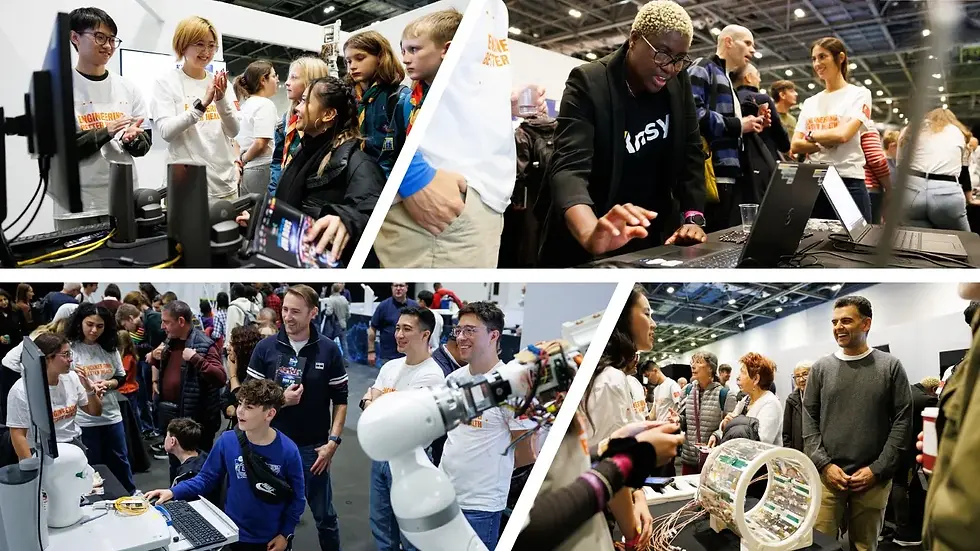
The children (aged 8) participated in nearly every activity: from a farming-zone tractor simulator, to a stand about how their Weetabix breakfast gets grown, to real-life tractors and soil-health experiments.
The “farming” section was especially memorable: two city kids from London thoroughly enjoyed seeing what goes into food production, the soil science behind it, and the real machines in action.
The stand-up talks and exhibits also spanned far: from making paper planes and becoming “pilots”, to exploring diving, robotics, diet & gut-science, quantum-computing and beyond. This wide variety kept children engaged and adults inspired.

One piece of feedback:
“The sheer number of activities, exhibitors and talks brought made the event accessible and enjoyable for different ages and stages … Watching my children freely move from one stand to another engaging in often complex concepts was inspiring to see.”That’s what we aim for at Young Minders — curiosity, movement, discovery.
Lessons for home educators
One of the biggest takeaways for us as home educators was realising how few opportunities there are that highlight agriculture and its connection to science, sustainability, and everyday life. The farming zone at New Scientist Live opened our eyes to how valuable it is to include agriculture in our teaching — from soil health to food systems, climate impacts, and the future of farming technology. It reminded us that science isn’t only found in labs and space stations, but also in the fields and farms that sustain us. We hope to incorporate more agriculture-focused learning into our future CREST and STEAM sessions, helping children understand the importance of sustainable food systems and environmental stewardship.

Why accessibility matters
The organisers have indicated that the event is now more hybrid (in-person + streamed) which helps accessibility for those who can’t attend physically. But for home-educating families, or families with limited budget/time, the cost of in-person tickets may still be prohibitive.
By working in partnership and securing discounted or donated tickets, our charity made attendance possible. One parent noted how without the discount they likely wouldn’t have been able to participate. This sort of partnership is a model worth repeating.
Reflecting on what can improve
Being honest, from the feedback:
Some felt that had they paid full price, their expectations would have been higher (for example: maybe a goodie-bag, or a one-to-one talk with a scientist, or extra “take-home” STEM projects).
While the variety was huge, for home-educated children of varying ages, it would help to have clearer “which zones best for ages 7-11 / 12-16” sign-posting ahead of time.
For future visits it would be great if the event organisers and partner charities could offer tiered ticketing → families with fewer resources + home learners, with guaranteed access to workshops or priority booking.
Why we’ll go back
Despite the few minor suggestions, this was a great event. Our families left buzzing: full of ideas, excited about what they’d seen and eager to bring that curiosity back into their home education. As one parent said:
“A great event, we will definitely come back next year!”We at Young Minders wholeheartedly agree. This is an opportunity we’ll plan into our annual calendar.
The home-education angle
From a home-education perspective the value is three-fold:
Real-world science in action — children see science not just on paper or in a classroom but live: farming tech, robotics, VR experiences, university research stands.
Choice and autonomy — the children got to roam, choose what intrigued them, engage according to their interests. That autonomy is a core benefit of home education.
Shared family learning — the whole family could explore together, ask questions, spark conversations at dinner about what they saw (e.g., “Why does soil health matter?”, “What is quantum computing doing for farming?”).
Looking ahead
We will compile a short “Top 10 picks” checklist for families before next year’s visit: best zones for various ages, lunch/rest-break strategies, how to manage a full day with younger children.
We’ll also work with the event organisers to confirm whether donated/discount tickets can become a regular option, especially for home-educating families.
At Young Minders we’ll create follow-up sessions: after the event we’ll host a workshop where children bring back one standout experience and build a small project around it (as we always do with our STEAM approach).
Conclusion
In short: New Scientist Live was a big opportunity, one that might be out of reach for many families but, with support, becomes accessible and richly rewarding. It ticks so many boxes: inspiration, hands‑on science, family learning, choice, and sheer joy in discovery. Thank you to the New Scientist Live team for putting on such an event. Thank you to our families for sharing your feedback. We’re already looking forward to next year!

If you’re a home-educating family or organisation interested in future opportunities like this or if you’d like to support us in making science and agricultural learning more accessible. Get in touch with Young Minders – The Home Education Hub. Together, we can keep opening doors for children to explore the world of science, sustainability, and innovation through real-world, hands-on experiences.

Comments